
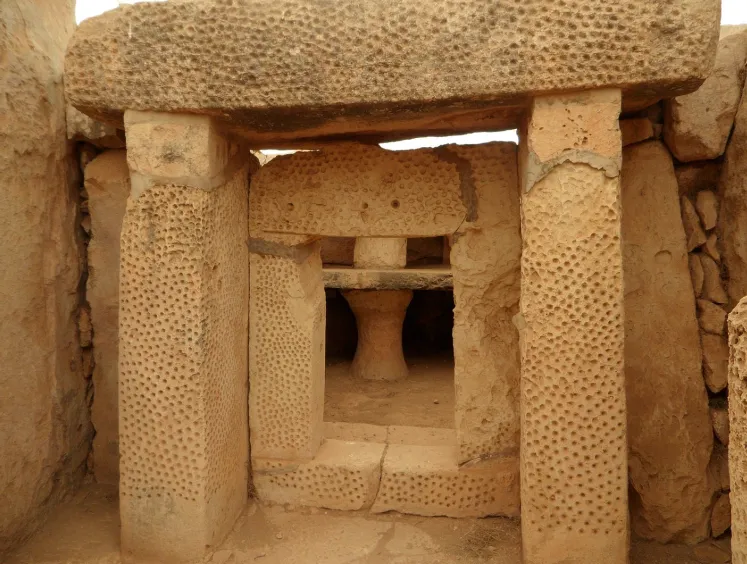
When you visit the islands of Malta and Gozo, you’ll discover the oldest megalithic temples in the world, including the Ġgantija temples on Gozo and temples like Ta’ Ħaġrat and Skorba on Malta.
These are freestanding stone structures dating from 3600 to 2500 BCE. These megalithic temples tell the story of mysterious cultures that lived on Malta at that time. The massive stones symbolize the mythical Atlantis and what no one fully understands: how did this civilization come to an end?
The temples were built over a period of 1,000 years, which we call the Maltese Temple Period. Different building techniques and styles were used in various phases. Did you know these temples are older than the pyramids in Egypt? They are even older than Stonehenge.
The Neolithic people of Malta and Gozo continued to build during this time, and each temple is part of a cohesive whole of symbolism.
Why these temples were built remains uncertain
No one knows exactly why these temples were built, but what has been found in these structures are religious imagery, carvings, and altars. There are central courtyards where gatherings likely took place, and in some temples, like Tas-Silġ, statues of fertility goddesses have been found. This culture continued through to the later Phoenician and Roman influences.
What is certainly interesting is the fact that these structures are aligned with the sun and moon. It’s thought that the temples have astronomical and perhaps astrological significance. At the Tal-Qadi temple, a stone has been found with symbols likely used to calculate moon phases.
All of this indicates that the temples were not merely architectural achievements but held deep spiritual and symbolic meaning for the community.
How were the temples built with such limited technology?
That’s an interesting question. In those times, people had nothing like we have today, yet these stone megaliths sometimes weighed up to 20,000 kilos and are certainly six meters high. And what’s most surprising is that the stones have withstood the test of centuries once set in place.
It is believed that the builders used wooden rollers and lever systems to move the heavy blocks. This would have been an enormous task since the islands were rugged and uneven terrain at the time. There was nothing flat.
The precision of stone dimensions is astounding
No two stones in a temple on Malta are exactly alike, but the precision with which the stones are carved is remarkable. Units that may have been used include, for instance, the dimensions of a hand or an arm. The accuracy they worked with is absolutely impressive and fascinating.
Archaeologists think that the builders used calculations either to make the stones or to perform astronomical calculations regarding moon phases.
This is particularly interesting in the case of temples that were specifically aligned with astronomical events.
Challenges and adaptations in building over time
Yet, the construction styles and techniques used throughout the period the temples were built were not uniform. We think the community living there made adjustments as the structures grew. Stones were even added to the original temples as late as the Bronze Age.
Abandonment and mystery after the temple period
It seems that, by the end of the temple period, the temples were intentionally destroyed, and Malta remained uninhabited for at least a century. This may have been due to social, political, or religious conflicts within the community.
Interested in visiting these temples? Book the best Malta tours here!